Having worked in the past in Liechtenstein and Switzerland for organizations that had, culturally, symbolically and materially, something to do with gold, I have always been fascinated by the strange aura surrounding this metal.
Gold is not only wealth. It is theatre. It is silence. It is fear made solid.
It does not speak, yet entire countries have built languages around it: discretion, neutrality, security, custody, continuity. In the Alpine world, these words acquire a particular geometry. They become stone walls, reinforced doors, train tunnels, military roads, mountain hotels, underground chambers and polished banking halls. They become architecture.
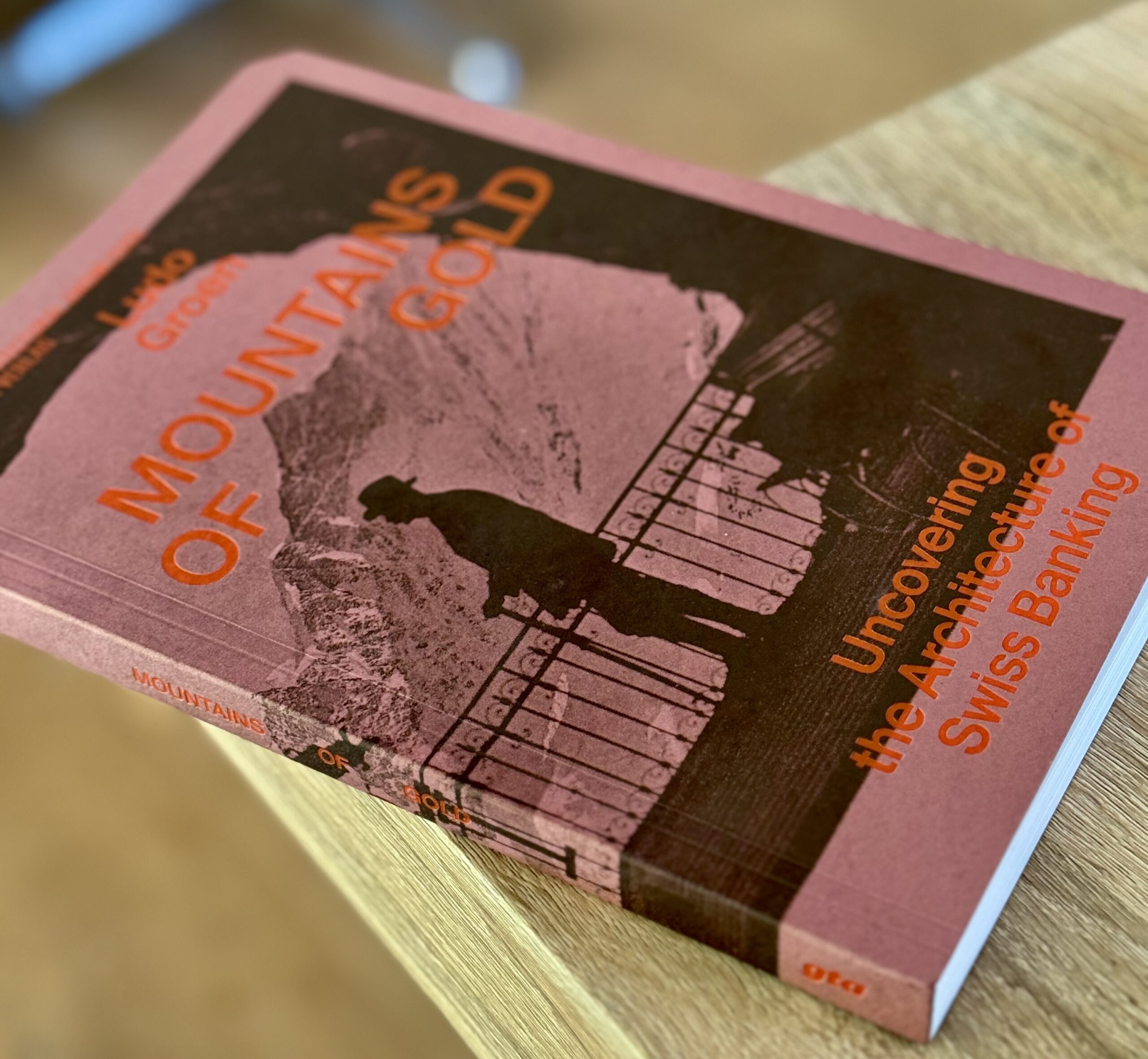
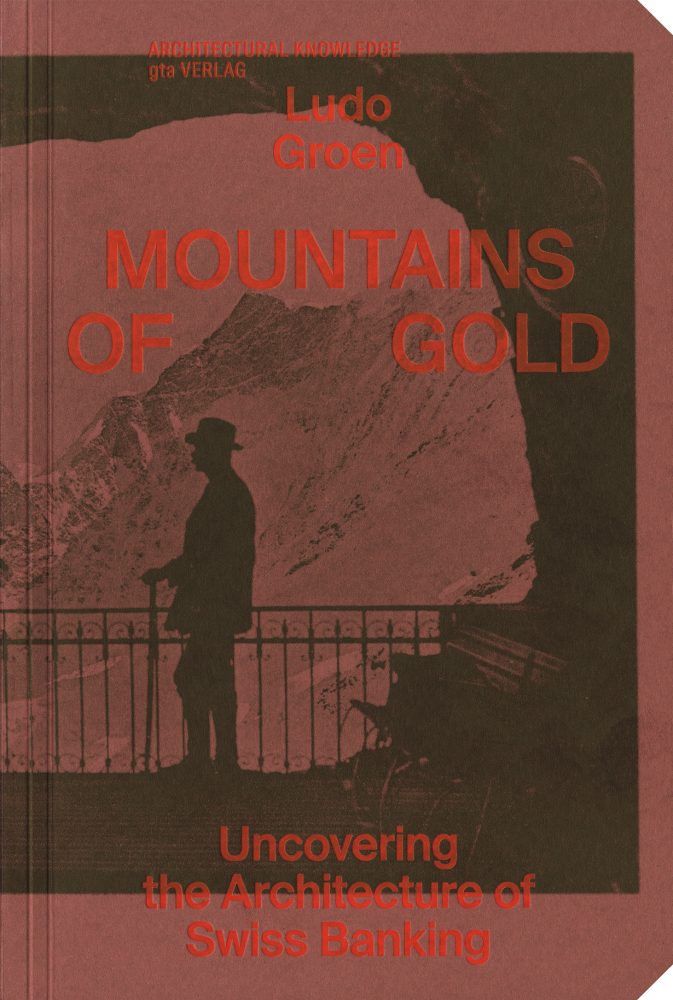
This is the disturbing brilliance of Ludo Groen’s Mountains of Gold: Uncovering the Architecture of Swiss Banking. The book does not simply ask how Swiss banks became central to the global gold trade. It asks where. It follows the metal into physical places: a railway station under the Jungfrau, a fortress in the Gotthard, an ammunition depot in Interlaken, a castle in Spiez, a gold mine in Welkom, a travel agency at Paradeplatz, a Swiss Centre in London and, finally, the cinematic fantasy of Piz Gloria. The table of contents itself reads like a map of a hidden state inside the official one.

And this is what makes the book so magnetic: it transforms Swiss financial history from abstraction into landscape.
We are used to imagining banking secrecy as a legal instrument, a signature, a coded account, a discreet office in Zurich or Geneva. Groen shows something more cinematic and more unsettling. Secrecy had walls. It had ventilation systems. It had railway schedules. It had guards. It had lunch receipts.
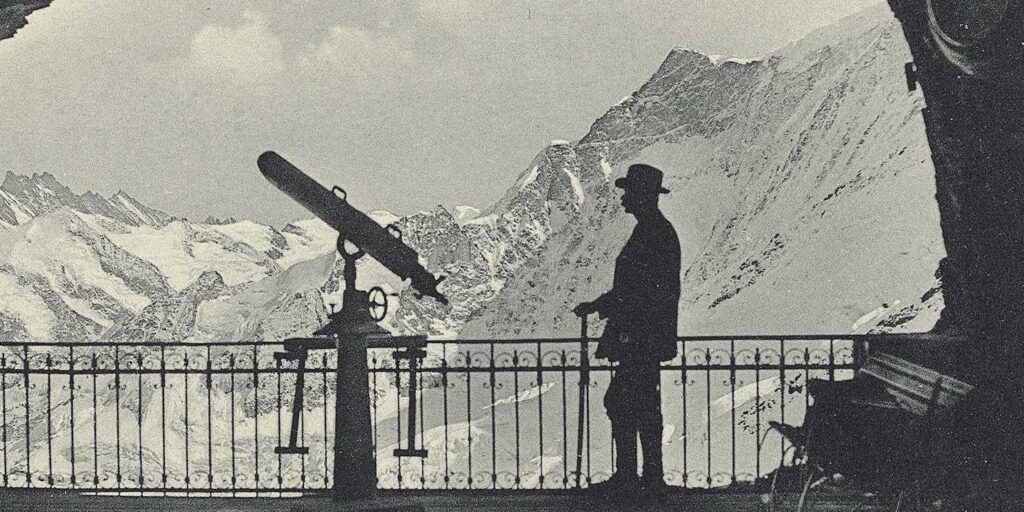
One of the most memorable episodes begins almost absurdly, high above the glacier. In 1938, with war approaching, the president of the Wengernalp and Jungfrau Railway offered the Swiss National Bank the Eismeer station as an evacuation site for its gold reserves. This was not a metaphor. It was a real proposal: store the nation’s treasure at 3,161 metres, above a crevassed glacier, inside Europe’s highest railway station of its time. The location was spectacular, almost mythological: electric carriages climbing below the Eiger, caves in the limestone, a restaurant near the abyss, a post office inside the mountain.
The idea was rejected because guarding such a remote site would have been too expensive and impractical. Yet the fact that it was even considered reveals the psychological architecture of the Swiss gold story. In a moment of danger, the imagination moved upward, inward, into the mountain.
This is the central spell of Switzerland: the mountain as both postcard and bunker.
The same Alps sold to tourists as purity, health and sublime beauty were also being evaluated as machines of concealment and survival. The Jungfrau, the Gotthard, Interlaken, Spiez and Gstaad were not only romantic destinations. They were part of an emergency geography of capital.
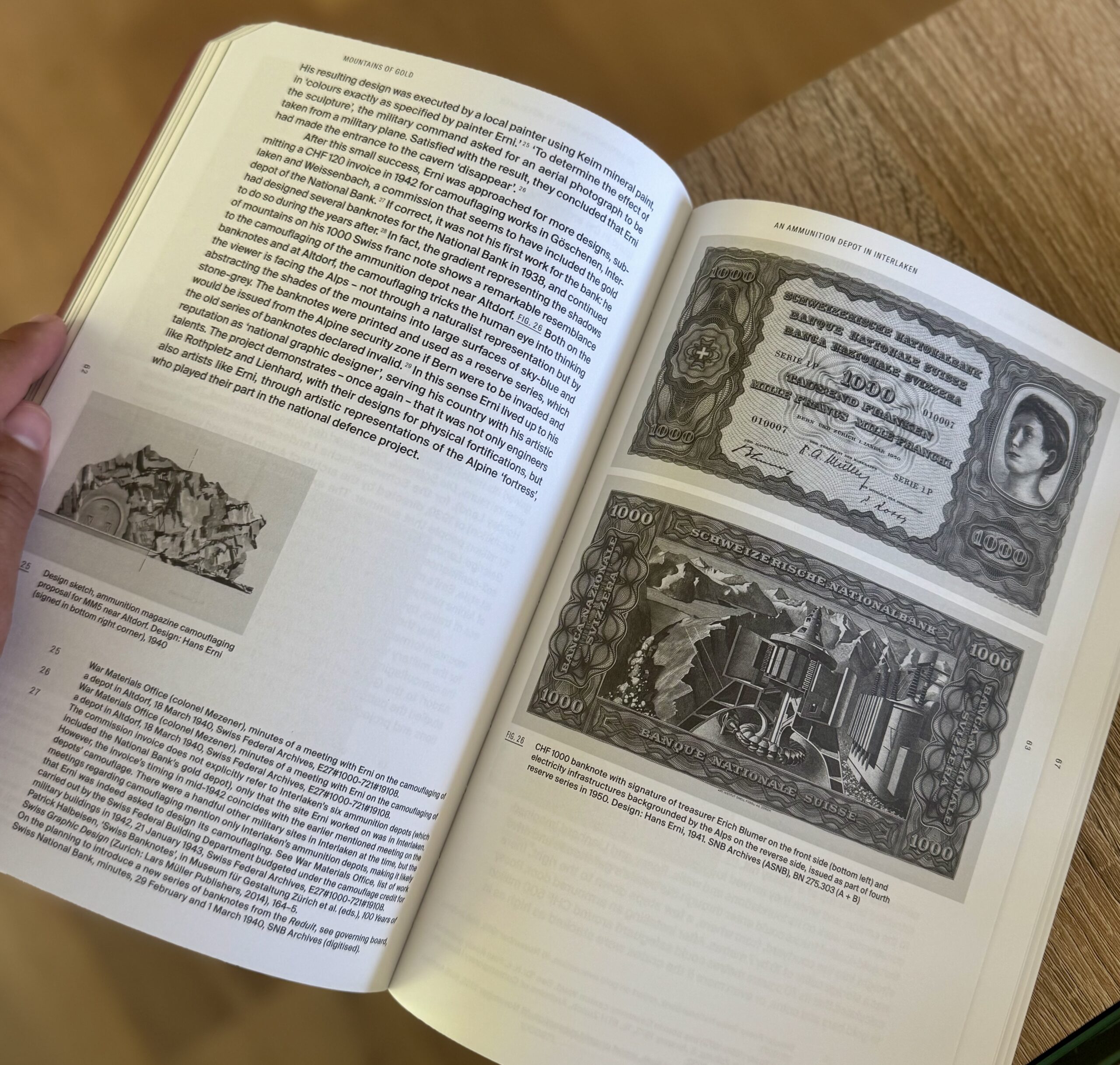
Groen’s protagonist in the early chapters is Erich Blumer, chief treasurer of the Swiss National Bank. In 1936, he calculated that evacuating the bank’s reserves would require 67 lorries to move banknotes, 22,000 gold bars and 12,000 bags of coins from Bern. Zurich held thousands more bars and bags. Suddenly, the problem of money became brutally physical. A balance sheet had weight. A currency had to be carried. Sovereignty had to fit into trucks.
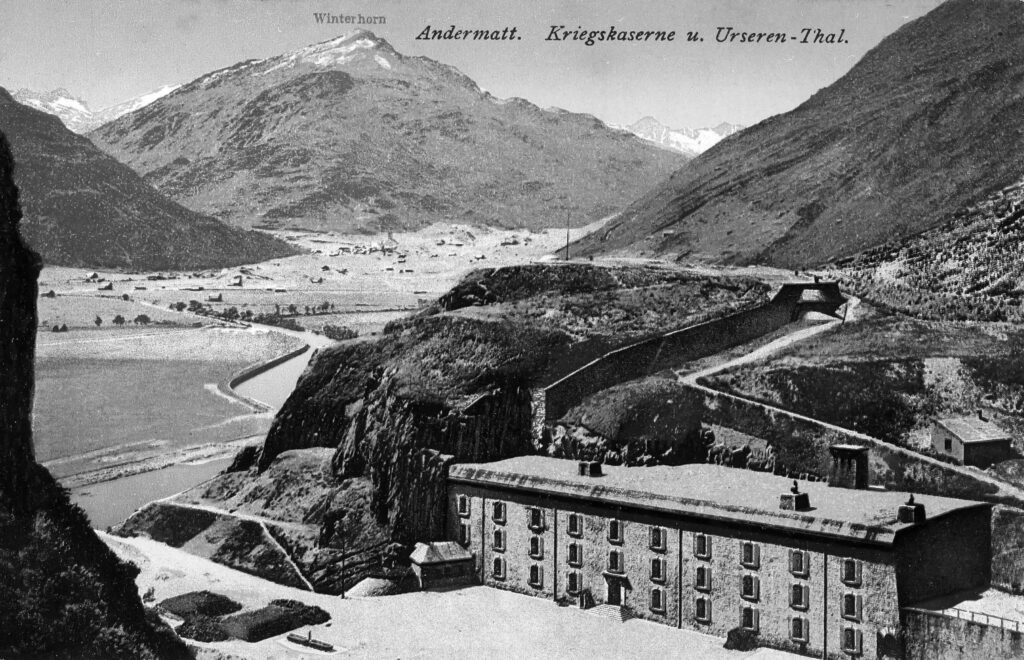
The old idea of the bank as a monumental urban palace was becoming obsolete. Aerial warfare had made cities vulnerable. The future of money, at least in wartime, was underground. The Swiss National Bank eventually chose Fort Bühl on the Gotthard Pass as a gold depot, a decision that fused financial policy with military infrastructure and national myth. The Gotthard was never just a pass. It was one of the symbolic cores of Swiss identity, a place where geology, engineering and patriotism already met.
Then comes Interlaken.
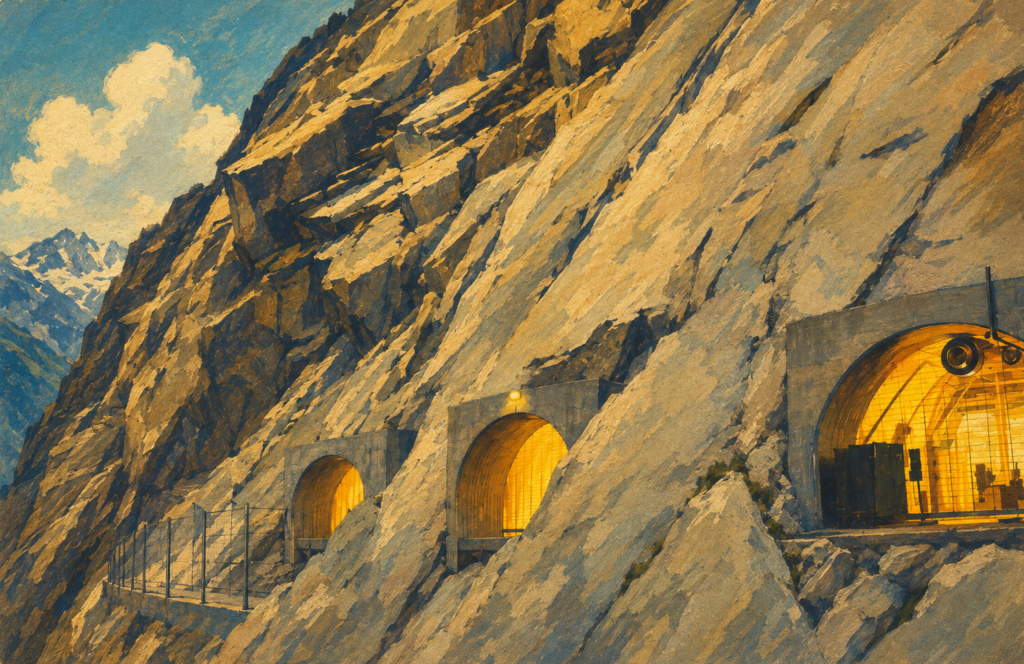
During the war, one of six heavy-duty ammunition magazines in the spa town was allocated as a second gold depot. Groen follows the seemingly banal traces of Blumer’s journeys there: expenses, petrol costs, meals, small logistical details. In one receipt from May 1940, CHF 62 covered miscellaneous expenses for a gold transport from Bern to the Interlaken depot, including lunch for two drivers and five carriers. Other records suggest that large transports involved two to four lorries and five to six men. With the 3-tonne trucks commonly used by the bank, a single delivery could carry up to CHF 50 million worth of gold.
This is where the book becomes almost noir.
Not because it invents suspense, but because the suspense is already hidden in administrative paper. A receipt becomes a corridor. A lunch becomes evidence. A road between Bern and Interlaken becomes a monetary artery. The drama is not in the spectacular gesture, but in the precision of the ordinary.
Gold does not move by magic. It moves because someone signs a form, someone starts an engine, someone opens a gate, someone drinks diluted wine to keep warm on the road.
The grand hotels add another layer of ambiguity. During the Second World War, Credit Suisse acquired a run-down hotel in Interlaken as an evacuation site for gold, banknotes and securities, while the Union Bank of Switzerland rented the Gstaad Palace and buried a vault under its sun terrace. The bank and the hotel begin to mirror each other: both promise discretion, service, controlled access, trust and an atmosphere of privilege. The guest and the depositor are not so different. Both enter a place designed to make anxiety disappear.
But the story does not remain in Switzerland.
After the war, Groen follows the gold supply chain to South Africa, where the metal was extracted under conditions inseparable from apartheid, environmental damage and the exploitation of Black mine workers. Swiss banks were involved in financing gold mining, while Swiss industrial technology, including machinery connected to companies such as Sulzer, helped make extraction possible. In the 1950s, some loans to South African entities were tied to the import of Swiss equipment, including turbines and pumps.
Here the Alpine myth begins to darken.
The clean white mountain, the secure vault, the elegant banker, the discreet hotel cellar: all of them depend on another landscape, far away, contaminated and exhausted. The gold that sleeps in Swiss stone has already passed through heat, dust, labour, violence and risk. The silence of the vault contains the noise of the mine.
Then, in 1968, the plot accelerates.
As the London gold market came under pressure, Zurich emerged as a central hub of the global gold trade. Groen describes the Zurich Gold Pool as a clandestine free gold market coordinated by major Swiss banks. The invisible infrastructure was not only financial. It was also telephonic, logistical and aerial. Female telephone operators handled the daily conference calls through which prices, purchases and sales were discussed. Swissair routes connected Zurich to Johannesburg. A new weekly flight to Johannesburg was scheduled to begin in April 1968, just as Zurich was positioning itself at the centre of the gold trade.
This detail is extraordinary because it shows how nations are built not only through laws and institutions, but through routes.
A gold market needs a runway. A banking centre needs an airline. A myth needs a travel agency window.
At Paradeplatz, Swissair’s travel agency sat in the plinth of the Credit Suisse headquarters. In London, the Swiss Bank Corporation, the Swiss National Tourist Office and Swissair opened the Swiss Centre in 1968, promoting an image of Switzerland as reliable, modern and secure. Banking, tourism and national branding were not separate worlds. They were mutually reinforcing surfaces of the same story.
And then James Bond appears, as if summoned by the myth itself.
Goldfinger and On Her Majesty’s Secret Service did not merely use Switzerland as a picturesque backdrop. They amplified the idea of Switzerland as the world’s safe deposit box. In Goldfinger, looted Nazi gold is melted into the bodywork of a Rolls-Royce and smuggled across Swiss mountain roads. The film’s Swiss scenes were shot near Andermatt, close to the Gotthard depot where the Swiss National Bank still held 19,845 gold bars at the time. The petrol station where Bond stops his Aston Martin was, according to Groen, roughly a kilometre from this real hidden reserve.
Cinema did what finance could not openly do. It made the myth visible.
The Alpine pass, the secret cargo, the villain, the refinery, the beautiful danger, the impeccable surface of control: all of it echoed the real architecture beneath the postcard. Even when Switzerland was associated with criminality in Bond films, the effect was strangely promotional. The message remained: this is where treasure goes when it must disappear safely.
That may be the deepest mystery of Mountains of Gold. The book is not only about gold, and not only about banks. It is about how trust is constructed.
Trust is not innocent. It is staged. It is engineered. It is lit like a hotel lobby, reinforced like a bunker, circulated like a tourist image, repeated through cinema, protected by archives and sometimes buried under mountains.
For someone who has moved through the cultural and financial atmospheres of Liechtenstein and Switzerland, and who is now exploring the intersection of digital and gold value, this book resonates beyond history. It touches something still present in the region’s symbolic code. Gold remains an object of fascination because it sits at the crossing of purity and opacity. It shines, but it hides. It appears timeless, but it always has a route. It feels natural, but it is produced by systems of extraction, custody, narration and power.
Ludo Groen’s achievement is to make those systems visible without destroying the mystery. In fact, the mystery becomes stronger. Once you know that vaults were hidden in fortresses, that hotels were prepared for evacuation, that castles received armoured doors, that flight routes and film sets helped build financial mythology, Switzerland becomes harder to look at casually.
A mountain is no longer just a mountain.
It may be a vault.
A railway station may be a contingency plan.
A grand hotel may be a financial instrument.
A Bond scene may be a footnote to monetary history.
And a gold bar, silent in the dark, may contain the architecture of an entire century.
More about the book, download, purchase and more: here.