

A manifesto for human agency
By Lodovico Minelli Sarteri
Abstract
Sovereign Intelligence asks one question. Does technology give people more power to act, or make them dependent on systems they cannot leave? The question runs through AI, money, biology, robotics, energy, space, networks and culture.
Technological progress should increase the capacity of people, communities and distributed systems to perceive, decide, create and cooperate—without reducing conscious life to an object of computation or making civilization permanently dependent on a central authority.
Sovereign Intelligence is a philosophy of progress, distributed capability and human freedom. It is the basis of my work in technology and venture strategy.
Sometimes separate events are part of one change.
AI, digital money, longevity, robotics, space, decentralized networks, brain interfaces and new energy look like separate industries. They are not. Each one changes the relationship between people, intelligence and power.
Elon Musk speaks about making humanity multiplanetary and extending consciousness beyond Earth. Federico Faggin, after helping create the microprocessor revolution, now argues that consciousness cannot be reduced to computation. Christian Angermayer invests across biotechnology, longevity, psychedelics and digital assets as parts of a broader vision of human possibility. Vitalik Buterin proposes a form of technological acceleration directed toward decentralization, defence and human agency. Balaji Srinivasan imagines communities that begin online and eventually acquire physical territory. Bryan Johnson treats his body as a continuously measured system that can be studied and improved. Patrick Collison and Tyler Cowen have called for a systematic science of progress. Stablecoins are giving people in unstable economies access to forms of money that were previously difficult or impossible to obtain.
These people do not belong to one movement. They often disagree. But each sees the same fact: technology is no longer making tools alone. It is changing the conditions of human life.
We lack a clear language for this change.
Effective accelerationism argues that technological progress should move faster. Libertarianism defends individual freedom against concentrated authority. Technocracy places confidence in expert knowledge and rational administration. Longtermism asks us to consider the interests of future generations. Transhumanism explores the extension of human capability through science. Progress studies investigates the conditions that allow societies to improve. Panpsychism and consciousness research challenge the idea that reality can be explained entirely through matter and computation.
Each tradition sees part of the world. None sees the whole.
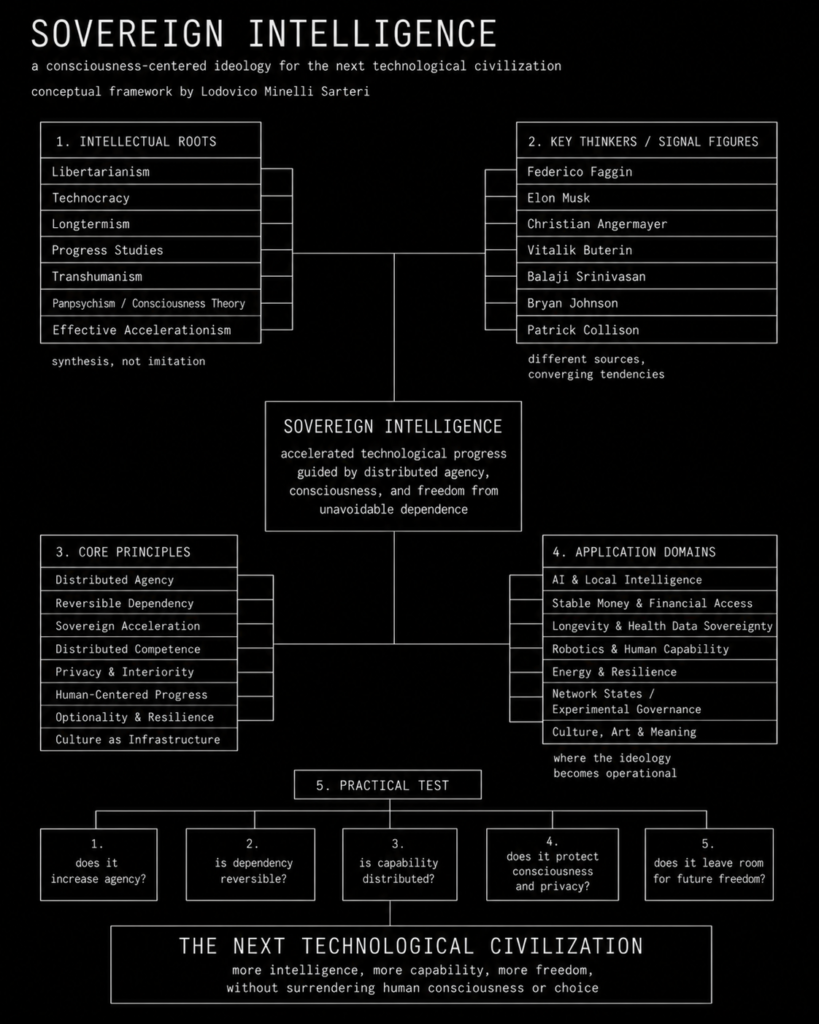
I call the connecting framework Sovereign Intelligence.
The ideas are not mine alone. My work is to connect them and name the missing principle. Progress should distribute agency, protect consciousness and preserve real choice.
Every important technology should face the same test:
Does this system make intelligence and capability more widely available, or does it make people more dependent on powers they cannot understand, influence or leave?
That question is the starting point of this manifesto.
Learning to Open the Machine
My relationship with technology began before computers became elegant, sealed and invisible.
During summer jobs in the early 1990s, I assembled personal computers. This involved handling motherboards, processors, memory modules, cables and drives, then discovering that a machine which appeared correctly assembled could still refuse to start. There were no intelligent assistants explaining the problem. You learned through manuals, conversations, experimentation and mistakes.
What fascinated me was not only what the computer could do. It was the fact that it could be opened.
A computer looked complete from the outside, but inside it was a system of relationships. Each component had a function. Each connection could be studied. Failures were not supernatural events. They were clues.
This experience gave me a lasting instinct: technology is most empowering when the person using it retains some ability to understand, adapt, repair and, when necessary, reject it.
The personal computer was revolutionary because it moved computational power away from a small number of institutions and placed it on an individual desk. It allowed people to write, calculate, publish, create music, design images and eventually connect to global networks without requesting access to a mainframe controlled elsewhere.
The computer became personal before intelligence became centralized again.

In the years that followed, I participated with friends in early hacking events and moved through cultural environments around squats in different European cities. Computer culture intersected with electronic music, underground publishing, graffiti, street art and political experimentation. These places were often disorganized and contradictory. I do not remember them as a perfect lost world. Their value came from something simpler: people did not wait for permission to create.




An abandoned building could become a workshop, a cultural centre or a temporary laboratory. A wall or train could become a public medium. A computer network could become a community. Technical knowledge moved between friends and strangers rather than only through official institutions.
Graffiti artists and hackers shared a similar intuition. Both looked at systems whose surfaces had already been assigned a purpose and asked whether another use was possible. One intervened in physical space. The other intervened in computational space. Both asserted a right to authorship.


The deeper question was always the same: who is allowed to shape the environment in which everyone else must live?
Years later, when I travelled through early cryptocurrency networks in Europe, Asia and the United States, I recognized the same instinct in a more sophisticated form. Bitcoin was a monetary technology, but it was also a philosophical event. It demonstrated that something as fundamental as money could be reconsidered as an open system rather than accepted as an eternal institutional arrangement.
Trust could be distributed. Value could move through a network without requiring a central issuer. People who had never met could coordinate around a transparent set of rules.
Crypto later developed its own elites, speculative excesses, institutions and concentrations of power. Some projects rebuilt the very structures they claimed to replace. The word decentralization became a marketing device as often as it remained a technical principle.
Yet the original revelation survived: many structures that appear permanent are actually design choices.
If they were designed, they can be redesigned.
My later work across startup, investment and innovation ecosystems added an important correction to the early countercultural instinct. It is easier to criticize institutions than to build alternatives that function reliably. A serious system requires engineering, capital, governance, distribution, manufacturing, communication, trust and cultural legitimacy. A philosophy matters only when it can become operational.
Sovereign Intelligence comes from this intersection between counterculture and execution, between the desire to open systems and the recognition that open systems must still work.
The Age of Rented Intelligence

Artificial intelligence is often described as a product category. In reality, it is becoming a layer of civilization.
It will influence how people learn, work, communicate, invest, diagnose illness, create companies, conduct scientific research and interpret the world. It will not simply answer questions. It will increasingly shape which questions are asked and which possibilities appear reasonable.
This could become one of the greatest expansions of human capability in history. A person without access to elite institutions may gain a tutor, translator, research assistant, designer, programmer and strategic adviser. Small organizations may acquire capabilities previously available only to governments and large corporations.
But there is another possible outcome.
Most advanced artificial intelligence is currently delivered through centralized platforms. Users send their conversations, documents, business information, creative ideas and personal dilemmas to systems they do not own. The intelligence appears through a simple interface, but its infrastructure remains somewhere else. Access is conditional. Rules can change. Accounts can be suspended. Data accumulates outside the control of the person who produced it.
We are moving from owning tools to renting cognition.
Centralized AI is not automatically hostile to freedom. Large systems can provide capabilities that local devices cannot yet match. The problem begins when there is no meaningful alternative and no realistic path of exit.
A sovereign intelligence system does not have to be completely decentralized. It must, however, make dependency reversible. People should be able to move their data, retain their memory, use local models where privacy matters, understand how consequential decisions are made and continue operating when a provider changes its terms.
A doctor should be able to use AI without transferring permanent control of patient information to a technology company. A family should be able to build a private archive that is not silently absorbed into a commercial model. A business should not lose its accumulated intelligence because a platform account is closed. A community should be able to maintain essential knowledge during political instability or network failure.
Sovereignty is not the absence of all dependence. Modern life depends on cooperation. Sovereignty is the ability to avoid unavoidable dependence on a single authority.
This distinction is important because technological debates often become trapped between two unrealistic positions. One side imagines that every system should be fully decentralized and individually controlled. The other assumes that centralization is the inevitable price of convenience and scale.
Sovereign Intelligence proposes a different objective: build systems in which power may be coordinated centrally when necessary but can still be verified, contested, transferred or withdrawn.
The question is not whether there is a centre. The question is whether the centre can become a prison.
Federico Faggin and the Missing Half of Intelligence
Federico Faggin occupies a central place in this philosophy because his intellectual journey connects two eras that are too often separated: the creation of computational intelligence and the investigation of consciousness.
Faggin was a leading figure in the development of the Intel 4004, the first commercial microprocessor, and later contributed to processors that helped make personal computing possible. Decades afterward, he turned his attention toward a question that the technology industry usually avoids: what if consciousness cannot be reduced to computation?
This is not a minor philosophical disagreement. It affects how we understand human beings in an age of artificial intelligence.
The dominant computational view suggests that the brain is a biological information processor and that consciousness somehow emerges when information processing becomes sufficiently complex. In this view, a human being is ultimately a machine whose components are organic rather than electronic.
Faggin proposes a very different possibility. In his work with physicist Giacomo Mauro D’Ariano, he has explored a model in which consciousness is not produced by matter but is a fundamental aspect of reality. Their information-theoretical approach leads toward a form of quantum-information panpsychism, in which interior experience cannot be fully described from the outside. [1]
This remains a theoretical and disputed proposition. Sovereign Intelligence does not require belief in one final theory of consciousness. It does require us to take the problem seriously.
There is a difference between intelligence and experience. A system may process language, recognize images, construct arguments and solve difficult problems without necessarily experiencing colour, pain, memory, love, fear or meaning. A machine may describe grief without grieving. It may discuss mortality without confronting death.
This is the boundary that much of contemporary technology ignores.
If we decide that human beings are simply inefficient computers, then many forms of control can be presented as optimization. Behaviour can be predicted and directed. Attention can be engineered. Emotional life can be reduced to measurable signals. People can be evaluated according to productivity, compliance and machine-readable performance.
If consciousness has an irreducible interior dimension, then privacy becomes more than data protection. It becomes the defence of the space in which a person exists as a subject rather than an object of analysis.
This is the philosophical contribution Faggin brings to Sovereign Intelligence. Technology can expand intelligence without exhausting the meaning of consciousness. Machines can become extraordinarily capable without making human interiority obsolete.
The objective should not be to force human beings to compete with machines at being machines. It should be to use machines to create more space for the qualities that make human life worth experiencing.
Sovereign Intelligence is therefore consciousness-centred, but not anti-technology. It supports radical advances in AI, robotics, biotechnology and computation while refusing the claim that what cannot be computed does not matter.
Technological progress requires a philosophy of what must not be optimized away.
Elon Musk and the Importance of Civilizational Direction
Elon Musk demonstrates the strategic power of a civilizational mission.
SpaceX does not present itself merely as a company selling launch services. Its mission is to make humanity multiplanetary. Rockets, satellites, reusable launch systems and communications infrastructure are connected to a larger story about the long-term survival and expansion of civilization. [2]
This matters because ambitious technical organizations need more than market opportunities. They need a direction capable of connecting thousands of decisions over many years.
A mission of this kind changes how people interpret work. An engineer is not only reducing the weight of a component. An investor is not only financing transportation infrastructure. Both can understand themselves as contributing to a project larger than a single product cycle.
Musk’s language about preserving and extending consciousness also moves the project beyond conventional aerospace. Space becomes part of a philosophy of human continuity. Intelligence and consciousness should not remain confined to one vulnerable planet.
Whether one agrees with Musk’s politics, management or personal style is not the central issue here. The useful lesson is that technology becomes transformative when separate ventures are given civilizational coherence.
Space exploration, artificial intelligence, energy storage, communications, robotics and brain-computer interfaces can be treated as unrelated industries. They can also be seen as components of an effort to increase humanity’s reach, resilience and capability.
Sovereign Intelligence learns from the scale of this ambition, but it introduces a different condition. A system intended to expand human agency should not remain permanently dependent on a single exceptional founder.
Founder-led acceleration can move faster than institutional consensus, but it can also produce extreme concentrations of authority. A civilizational project should eventually become stronger than the personality that initiated it.
The practical lesson is not that every startup should claim to save humanity. Grand language without substance quickly becomes theatre. The lesson is that every serious technological ecosystem should understand the human capability it exists to expand.
SpaceX expands physical reach. Stable digital money can expand access to reliable value. Decentralized artificial intelligence can expand cognitive ownership. Preventive health systems can expand biological understanding. Encryption expands the ability to communicate without unwanted observation.
A mission becomes credible when it explains the relationship between a technology and a real increase in human agency.
Christian Angermayer and the Investable Future of the Human Being
Christian Angermayer represents another important tendency: investment portfolios are beginning to operate as philosophical systems.
Through Apeiron Investment Group and related ventures, Angermayer has invested across biotechnology, longevity, mental health, psychedelics, digital assets and frontier technologies. Apeiron describes its outlook as an optimism that technology can help people live longer, healthier and more fulfilling lives. [3]
The connecting theme is not a single market. It is the future of the human being.
This is significant because capital does more than fund companies. It can coordinate research, talent, narratives and institutions around a vision of what the future should contain. When investments across consciousness, finance, biotechnology and computation are placed together, the portfolio begins to resemble a theory.
Angermayer’s model suggests that the next major investment ecosystems may not be organized around traditional sector labels. They may be organized around human questions. How do we live longer? How do we understand consciousness? How do we treat mental suffering? How do we finance scientific risk? How do we increase the range of possible human experience?
Sovereign Intelligence shares this cross-sector perspective, but adds an important test: who eventually receives the capability?
A longevity treatment available only to billionaires may produce useful science, but it does not yet represent broad human sovereignty. A brain-computer interface can restore movement or communication, but the patient’s dependence on proprietary software and remote infrastructure becomes part of the medical question. A psychedelic therapy may help transform mental-health treatment, but access, ownership and institutional control will determine whether it becomes liberating or simply another expensive system.
The goal cannot be merely to create a technologically enhanced elite.
The goal must be to make human advancement progressively more available, affordable and understandable.
This is where Sovereign Intelligence differs from conventional transhumanism. Transhumanism often focuses on overcoming biological limits. Sovereign Intelligence asks who owns the technologies of transcendence, who controls the data they generate and whether people remain free to accept, refuse or modify them.
A more capable human being who is permanently dependent on an external system is not fully sovereign.
Stable Money and the Geography of Financial Freedom
The meaning of a technology changes depending on where it is used.
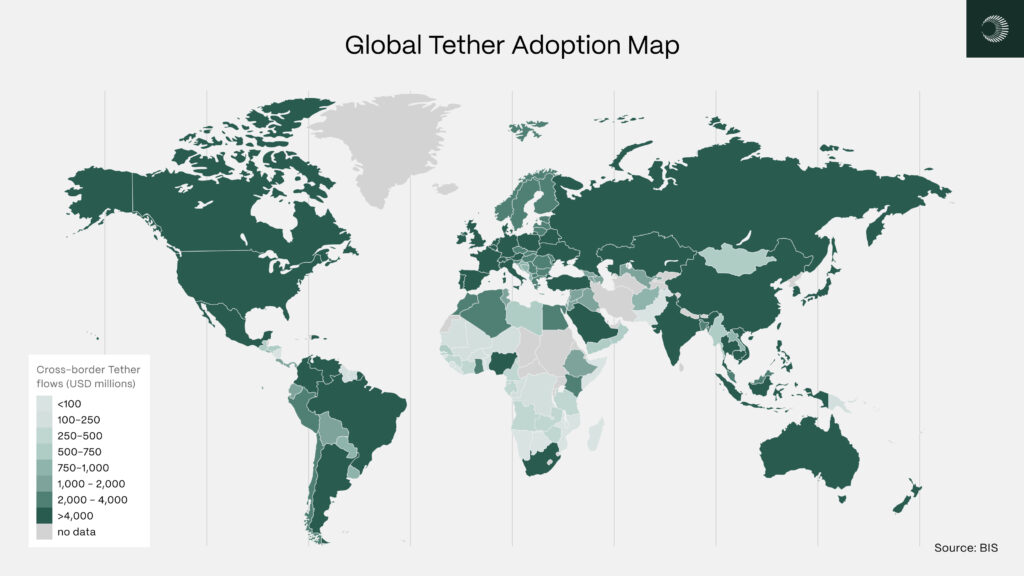
For someone living in a country with a stable currency, reliable banks and inexpensive payments, a dollar-denominated stablecoin may appear to be a technical convenience. For someone facing rapid inflation, currency restrictions, expensive remittances or limited banking access, it can become a practical instrument of survival.
This is why Tether, without needing to become the institutional centre of this ideology, provides an important example.
USD₮ has enabled people in many emerging markets to hold and transfer dollar-denominated value through digital networks. Tether has increasingly framed this infrastructure around financial inclusion, remittances and access for people living outside reliable banking systems. Its integrations and investments have focused on regions where stable value and cross-border settlement solve immediate problems rather than speculative ones. [4]
A freelancer can receive payment from abroad. A migrant worker can send money to relatives. A small company can settle an international transaction. A family facing local currency depreciation can preserve part of its purchasing power.
Stablecoins do not create complete financial sovereignty. Users remain exposed to the quality of the reserves, the governance of the issuer, the security of wallets, local regulation and the networks through which the tokens move. A digital dollar also extends the reach of the dollar rather than replacing the existing monetary order.
Yet sovereignty should not be confused with ideological purity.
For many people, the first step toward greater financial freedom is not the elimination of every intermediary. It is the existence of a usable alternative.
This is one of the practical insights of Sovereign Intelligence: optionality is often more important than theoretical perfection. A person becomes more sovereign when they can choose between systems, move value across them and reduce dependence on a single fragile institution.
The same principle applies beyond money. Local AI does not need to replace every cloud model. Renewable microgrids do not need to disconnect every community from the national network. Self-custody does not need to be the first step for every new user.
Sovereignty can be progressive.
A good system allows a person to begin with convenience and gradually acquire more control, knowledge and responsibility. It offers a ladder rather than demanding an immediate leap.
Stable digital money also demonstrates why technological progress must be evaluated globally. The problems that dominate discussion in San Francisco, London or Zurich are not always the problems that matter most in Lagos, Buenos Aires, Istanbul or Manila.
A tool that saves ten minutes in a wealthy economy may save days, fees or purchasing power somewhere else.
Sovereign technology should be judged from the margins as well as the centre.
Vitalik Buterin and Acceleration With a Steering Wheel

Effective accelerationism has provided a powerful response to the pessimism surrounding technology. Its basic instinct is that innovation should not be blocked by excessive fear, bureaucracy or cultural stagnation.
This instinct matters. Societies that lose confidence in building eventually become incapable of solving their own problems. Housing, energy, medicine, transportation and scientific research can all become trapped by systems that are excellent at identifying risk but poor at permitting progress.
The weakness of accelerationism is that speed alone does not provide direction.
A surveillance system can accelerate. A centralized artificial intelligence monopoly can accelerate. Autonomous weapons can accelerate. Behavioural manipulation can become more efficient. A society may increase its technical capability while reducing the agency of nearly everyone inside it.
Vitalik Buterin’s concept of defensive or decentralized acceleration, commonly shortened to d/acc, provides a more useful distinction. Buterin argues for accelerating technologies that strengthen defence, decentralization and human flourishing rather than simply increasing every available capability. His broader work continues to emphasize permissionlessness, verifiability, privacy and resistance to centralized control. [5]
Sovereign Intelligence develops this insight further.
Acceleration should be evaluated according to where power accumulates. A useful technology does not merely perform better. It changes the distribution of capability.
Does it allow more people to act? Does it make a system easier to verify? Does it strengthen defence against coercion? Does it preserve a meaningful human role Does it allow people to exit?
Sovereign Intelligence therefore supports acceleration, but not acceleration without a steering wheel. I call this sovereign acceleration: the rapid development of technologies that increase distributed agency while resisting irreversible concentrations of control.
Artificial intelligence should accelerate, but local and open models should accelerate with it. Biotechnology should accelerate, but patient ownership of biological information should develop at the same time. Financial networks should accelerate, but portability and self-custody should remain possible. Robotics should accelerate, but the gains in productivity should not be designed solely for the owners of the machines.
The objective is not to slow down the future. It is to prevent the future from becoming a structure that most people can enter only as dependants.
Balaji Srinivasan and the Reorganization of Geography
Balaji Srinivasan’s network-state thesis begins with the observation that communities can now form online before they occupy a shared territory.
Historically, political identity was largely inherited from geography. People belonged to a state because they were born inside its borders. The internet allows communities to form around interests, values, professions and missions before their members live near one another.
Srinivasan imagines highly aligned online communities that develop economic systems, governance structures and collective capacity, then acquire physical locations distributed across the world. In his model, the network comes first and the territory follows. [6]
The idea is controversial, but it identifies a real shift. Remote work, digital money, online education and global professional networks have weakened the automatic relationship between identity and place. People may feel more connected to a technological community across several continents than to neighbours with whom they share only an administrative jurisdiction.
Sovereign Intelligence does not assume that startup societies should replace nation states. A society is not simply a company, and citizenship cannot be reduced to a subscription. Communities also contain disagreement, vulnerability and obligations that cannot always be solved by leaving.
However, network-state experiments reveal that governance itself can become an area of innovation. Cities, regions, campuses and distributed communities can test new approaches to digital identity, health, energy, education, finance and collective decision-making.
The important principle is not secession. It is experimentation.
A sovereign society should make room for smaller environments in which new systems can be tested without requiring an entire country to change at once. Some experiments will fail. Others may become models that existing institutions adopt.
The future may not consist of one new global system. It may consist of many interoperable communities, each testing a different balance between technology, culture and governance.
Sovereignty in this context is not isolation from the world. It is the ability to form meaningful associations across inherited borders.
Bryan Johnson and the Body as an Information System
Bryan Johnson has turned longevity into a public experiment.
Through Blueprint and the Don’t Die movement, he has organized much of his life around measurement, routines, biological testing and the reduction of preventable decline. His approach is extreme, expensive and not directly transferable to most people. Some of its claims require more scientific evidence.
Yet Johnson has made an important cultural intervention. He has transformed the body from something people monitor only when it fails into something that can be observed continuously and discussed openly. He presents health as a system in which data, habits, environment and biological response can be examined together. [7]
This tendency will extend far beyond one individual. Wearables and new sensors will increasingly measure sleep, heart activity, stress, metabolism, hormones, neurological signals and emotional states. Artificial intelligence will find patterns in these signals that a person or doctor could not identify unaided.
The potential benefits are enormous. Medicine could become more preventive, personalized and continuous. People may detect changes before symptoms become severe. Treatments may become more precise.
The risk is equally significant.
Biological data is not ordinary consumer information. It is an evolving record of the person. It can reveal vulnerability, behaviour, illness, stress and future risk.
Who owns this record? Can an employer access it? Can an insurer use it to alter prices? Can a platform sell emotional predictions to advertisers? Can an algorithm quietly classify a person as unreliable, unhealthy or expensive?
The body may become the next major platform, and it could become the most difficult platform to leave.
Sovereign Intelligence therefore treats biological sovereignty as a core principle. Health technology should operate for the person first. Data should remain private and portable. Local analysis should be used when possible. A measurement should inform a human decision rather than become an invisible verdict.
The objective is not to quantify every aspect of life. It is to use measurement without allowing the measurable to define the whole person.
Faggin’s philosophy returns here. The externally observable human being is not identical to the internally experienced self. A dataset may describe the body, but it does not contain the complete reality of the person living through it.
Patrick Collison and the Recovery of Progress
Patrick Collison and Tyler Cowen introduced the idea of progress studies as a dedicated effort to understand why some societies achieve major scientific, technological, cultural and organizational advances while others stagnate. [8]
This is an important correction to the belief that progress happens automatically. New medicines, infrastructure, energy systems and technologies do not appear simply because time passes. They emerge from particular combinations of institutions, incentives, knowledge, tolerance for risk and cultural ambition.
Modern societies often enjoy the results of past progress while becoming less capable of producing progress themselves. They become more skilled at managing existing systems than imagining better ones.
Sovereign Intelligence shares the optimism of progress studies, but adds two questions.
Progress for whom? Control by whom?
A society can become wealthier and more technically capable while concentrating decision-making inside a narrow group. It can produce extraordinary services while making citizens dependent on systems they cannot inspect. It can increase average life expectancy while turning health information into a mechanism of control.
Progress must therefore be evaluated not only through aggregate outcomes but through the distribution of agency.
This does not mean every innovation must produce equal results for everyone immediately. New technologies are often expensive and imperfect before they become widely available. The relevant question is whether the system is moving toward broader capability or toward permanent exclusion.
Sovereign Intelligence is a theory of progress with a direction: more intelligence, more capability and more choice should reach more people over time.
From Technocracy to Distributed Competence
Complex societies need experts. Artificial intelligence, finance, biotechnology and energy cannot be governed through slogans or intuition alone.
Technocracy begins with this reasonable observation. Decisions should be informed by knowledge, evidence and technical competence.
The danger appears when expertise becomes unaccountable authority. Specialists can understand a narrow system while missing its wider consequences. Models can optimize measurable results while excluding human values that are difficult to quantify. Institutions can use complexity as a defence against public scrutiny.
The alternative is not anti-intellectual populism. Rejecting expertise would make society less sovereign, not more.
Sovereign Intelligence proposes distributed competence.
Distributed competence means that expert knowledge remains central, but its assumptions, methods and incentives are open to examination. Systems should be auditable. Important decisions should be explainable. Independent experts should be able to challenge official conclusions. Users and citizens should have meaningful avenues of appeal.
Not everyone needs to understand every line of code. But someone outside the institution should be able to inspect it.
This resembles the logic of open-source software. Most users will never examine the source, but the possibility of examination changes the balance of trust. Authority becomes more credible because it is not completely shielded from verification.
The goal is not government by technicians. It is a society in which technical competence is widely cultivated and institutional competence remains contestable.
Technocracy asks us to trust the best experts.
Sovereign Intelligence asks us to build systems in which expertise can earn trust without becoming a permanent monopoly on truth.
A Libertarianism of Capability
Libertarianism correctly identifies concentrated coercive power as a persistent danger. It defends voluntary association, property, choice and the freedom to exit.
However, formal freedom is not always practical freedom.
A person may be legally free to leave a platform while having no viable alternative. A creator may formally own their work while depending on one algorithm for access to an audience. A patient may technically consent to data collection while having no realistic access to treatment without it.
Freedom requires more than the absence of prohibition. It requires the presence of capability.
A person needs knowledge, infrastructure, tools and alternatives. The ability to choose is meaningful only when more than one option can actually be used.
Sovereign Intelligence is therefore libertarian in its suspicion of concentrated authority, but constructive in its response. It does not ask only what governments and corporations should stop doing. It asks what individuals and communities must be able to do for themselves.
Can they hold and transfer value? Can they operate intelligence privately? Can they communicate securely? Can they understand their own health information? Can they change providers without losing their history? Can they participate in technological systems without surrendering all control?
Freedom is not simply being left alone. It is having the means to act.
Long-Term Thinking Without Sacrificing the Present
Longtermism asks us to consider the interests of future generations. This is necessary because the systems being built today may influence civilization for centuries.
Artificial intelligence, biotechnology, energy infrastructure and financial protocols can create effects that outlive their designers. Future people cannot vote in our elections, attend our board meetings or reject our terms of service.
The weakness of extreme longtermism is that hypothetical future populations can become more important than actual people. Present suffering may be treated as a small variable compared with speculative events thousands of years away.
Sovereign Intelligence takes a more grounded approach.
The best way to respect future generations is to leave them systems they can understand, repair and change.
Open standards are long-term. Education is long-term. Privacy is long-term because information surrendered today may remain exploitable for decades. Decentralization is long-term when it prevents one failure from destroying an entire system. Institutional pluralism is long-term because it prevents one worldview from closing every alternative.
We should not attempt to determine the final form of the future. We should preserve the future’s ability to act.
The useful question is not whether a technology will remain unchanged for one hundred years. It is whether people one hundred years from now will still have the freedom to change it.
Culture as Civilizational Infrastructure
Technological movements routinely underestimate culture.
Engineers may assume that the best system will win because it is more efficient. Investors may assume that capital and market incentives are sufficient to determine adoption. Neither is true.
People understand technology through stories, symbols, rituals, identities and places.
Bitcoin is not only a protocol. It carries a mythology of anonymous creation, scarcity and independence. SpaceX is not only a launch company. It represents a story about humanity becoming a spacefaring civilization. The Don’t Die movement is not only a collection of health routines. It dramatizes a conflict between biological decline and conscious intention.
Culture gives technical systems meaning.
My earlier experiences around graffiti and street art taught me that a symbol can transform how people perceive a place before the physical structure changes. A neglected wall becomes visible because someone writes on it. An abandoned building becomes a cultural node because people inhabit it differently.
The same is true of technological ecosystems. A group of investments in finance, AI, robotics, energy, health and culture may look like an unrelated portfolio until someone articulates the worldview connecting them.
This is not branding in the superficial sense. It is intellectual architecture.
The next technological civilization will need artists, philosophers, writers, curators and cultural strategists alongside engineers and investors. It will need public spaces in which people can encounter new ideas outside technical interfaces. It will need symbols capable of making abstract systems emotionally and culturally legible.
A protocol can change how value moves. A cultural movement changes what that movement means.
Culture is not decoration added after the technology is finished.
Culture is the layer through which infrastructure becomes civilization.
The Practical Doctrine
Sovereign Intelligence is not valuable if it remains only an attractive phrase. It must alter the way technologies, investments and institutions are evaluated.
The doctrine begins with agency. A sovereign technology should give a person or community a meaningful capability they did not previously possess.
It then considers dependency. Every sophisticated system produces some dependence, but that dependence should remain visible and, where possible, reversible. Users should be able to leave, transfer their information, change providers or continue operating in a reduced form.
It examines the distribution of capability. A system that gives enormous power to its operator while giving everyone else only convenience may be innovative, but it is not sovereign.
It protects interiority. Privacy, consciousness, ambiguity and the right not to be continuously measured must remain part of human life.
It considers durability. Systems should be designed so that future participants can understand, repair and modify them.
Finally, it recognizes culture. A technology becomes civilizational only when people can understand why it exists and integrate it into a meaningful vision of life.
These principles will not always align neatly. Privacy can reduce convenience. Decentralization can slow coordination. Resilience can increase cost. Personal control can create personal responsibility.
Sovereign Intelligence does not pretend that trade-offs can be eliminated. Its purpose is to make those trade-offs visible and ensure that efficiency is not always allowed to defeat freedom by default.
Applied to artificial intelligence, it favours local models, portable memory, open protocols, privacy-preserving computation and human accountability.
Applied to finance, it favours accessible stable value, transparent reserves, cross-border interoperability, self-custody options and the freedom to move between systems.
Applied to health, it favours user-controlled data, preventive intelligence, informed consent and technologies that support rather than replace human judgment.
Applied to energy, it favours diversified production, local resilience and systems capable of surviving central failure.
Applied to governance, it favours experimentation, transparency, plural institutions and meaningful exit.
Applied to investment, it asks whether a portfolio is merely collecting profitable companies or constructing an ecosystem that expands human capability.
Applied to culture, it asks which images, narratives, institutions and public spaces can make a more sovereign future imaginable.
A Name for What Comes Next
Sovereign Intelligence is not another theory claiming to have solved every political and technological problem.
It is a baseline ideology for navigating convergence.
It takes useful ideas from several traditions. Accelerationism says build. Libertarianism warns against concentrated power. Technocracy respects competence. Longtermism remembers future generations. Transhumanism challenges needless limits. Progress studies asks how improvement happens. Faggin reminds us that consciousness may be more than computation.
But Sovereign Intelligence belongs entirely to none of them.
Its principle is direct. Technology should help people perceive, decide, create and cooperate. It should not make them permanently dependent on one authority. It should not reduce conscious life to data.
This is the synthesis I am proposing.
I reached this view through worlds that rarely speak. Building computers taught me to open the machine. Hacker culture taught me to question its intended use. Graffiti showed that control of space is also control of imagination. Crypto showed that protocols can reorganize trust and money. Startups taught me that alternatives still need capital, skill and execution.
The same question followed me through each environment: Who is allowed to shape reality?
This question is now larger than any sector. Intelligence is moving into machines. Money crosses digital networks. The body is becoming measurable. Communities form beyond borders. Private groups hold powers once reserved for states.
The outcome will not be determined by technology alone. It will be determined by the values built into its architecture.
The future should not require a choice between progress and freedom.
We can build faster without giving up freedom. AI can grow while ownership spreads. Finance can open while choice remains. Longevity need not turn the body into a corporate dataset. Expertise need not become an unaccountable class.
This is not independence from everyone. Human beings become capable through cooperation.
It is freedom from unavoidable dependence on anyone.
This is the project I, Lodovico Minelli Sarteri, am calling Sovereign Intelligence: a consciousness-centred philosophy of technological progress, distributed capability and human agency.
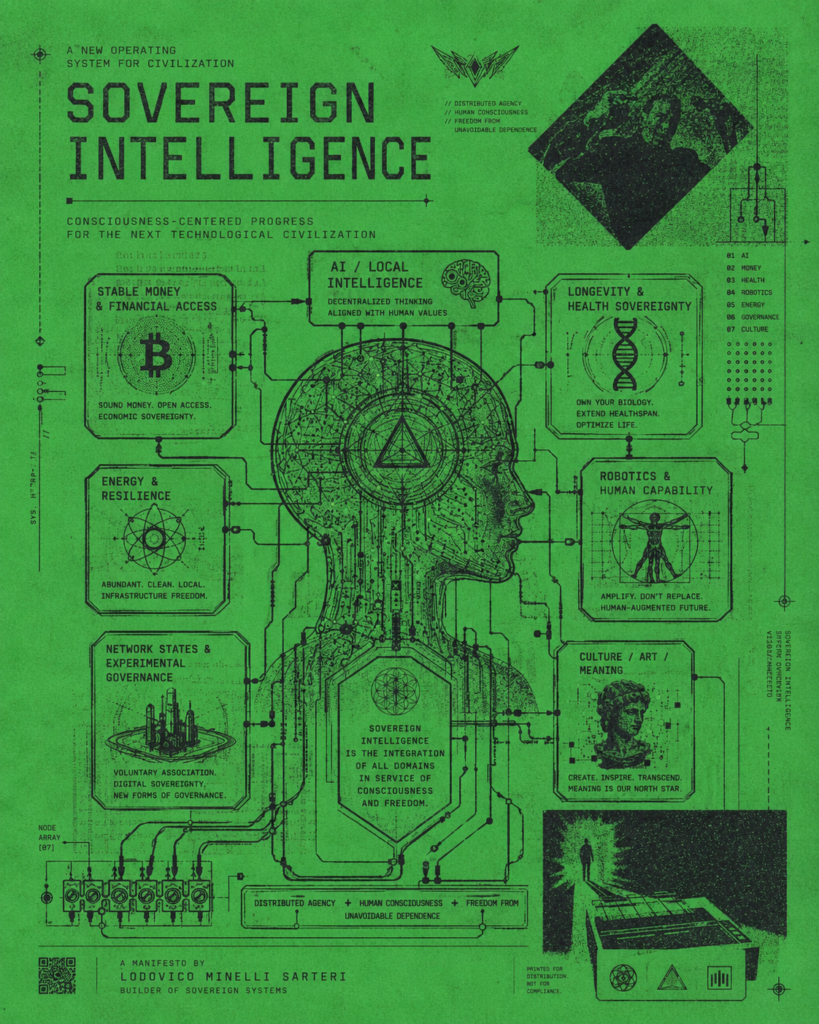
Its purpose is not to resist the future. Its purpose is to ensure that more people are able to participate in shaping it.
Source notes
[1] Federico Faggin: Intel’s history of the 4004 documents Faggin’s design leadership. Faggin and Giacomo Mauro D’Ariano develop a quantum-information-based panpsychist model in “Hard Problem and Free Will”. This remains a theoretical proposal rather than scientific consensus.
[2] Elon Musk and SpaceX: SpaceX’s mission page defines its work around making humanity multiplanetary and describes a spacefaring future as one grounded in the belief that the future can be better than the past.
[3] Christian Angermayer and Apeiron: Apeiron Investment Group describes its investment philosophy as long-term support for founders pushing technological boundaries, guided by optimism that technology can enable longer, healthier and more fulfilling lives.
[4] Tether and stable money: Tether’s MiniPay announcement describes stable, dollar-denominated access, savings and peer-to-peer transfers across emerging markets. Adoption figures cited there are company-reported.
[5] Vitalik Buterin: In “d/acc: one year later”, Buterin links technological progress with decentralization, censorship resistance, privacy, openness, formal verification and adversarial robustness.
[6] Balaji Srinivasan: The Network State describes an aligned online community that develops collective capacity and an economy before establishing a distributed physical presence and pursuing diplomatic recognition.
[7] Bryan Johnson: Don’t Die presents Blueprint as a data-driven attempt to rethink personal health, biological decline and humanity’s relationship with rapidly advancing AI. Its more ambitious health claims should be treated as experimental rather than established clinical conclusions.
[8] Progress studies: Patrick Collison and Tyler Cowen proposed the field in “We Need a New Science of Progress”, calling for systematic study of the economic, technological, scientific, cultural and organizational conditions that improve living standards.
About the author
Lodovico Minelli Sarteri is a frontier technology strategist, entrepreneur and venture advisor. He works across AI, digital finance, biotech, human capability and culture. He advises founders, investors, family offices and institutions on technology, venture strategy and positioning.
Explore Frontier Intelligence →
Advisory engagements →
Start a conversation →
About →
LinkedIn →
SARTERI.com is the personal website and independent blog of Lodovico Minelli Sarteri.