
A raw Sarteri analysis of the ownership, financial architecture and operating system behind the Italian company buying some of the internet’s best-known names.
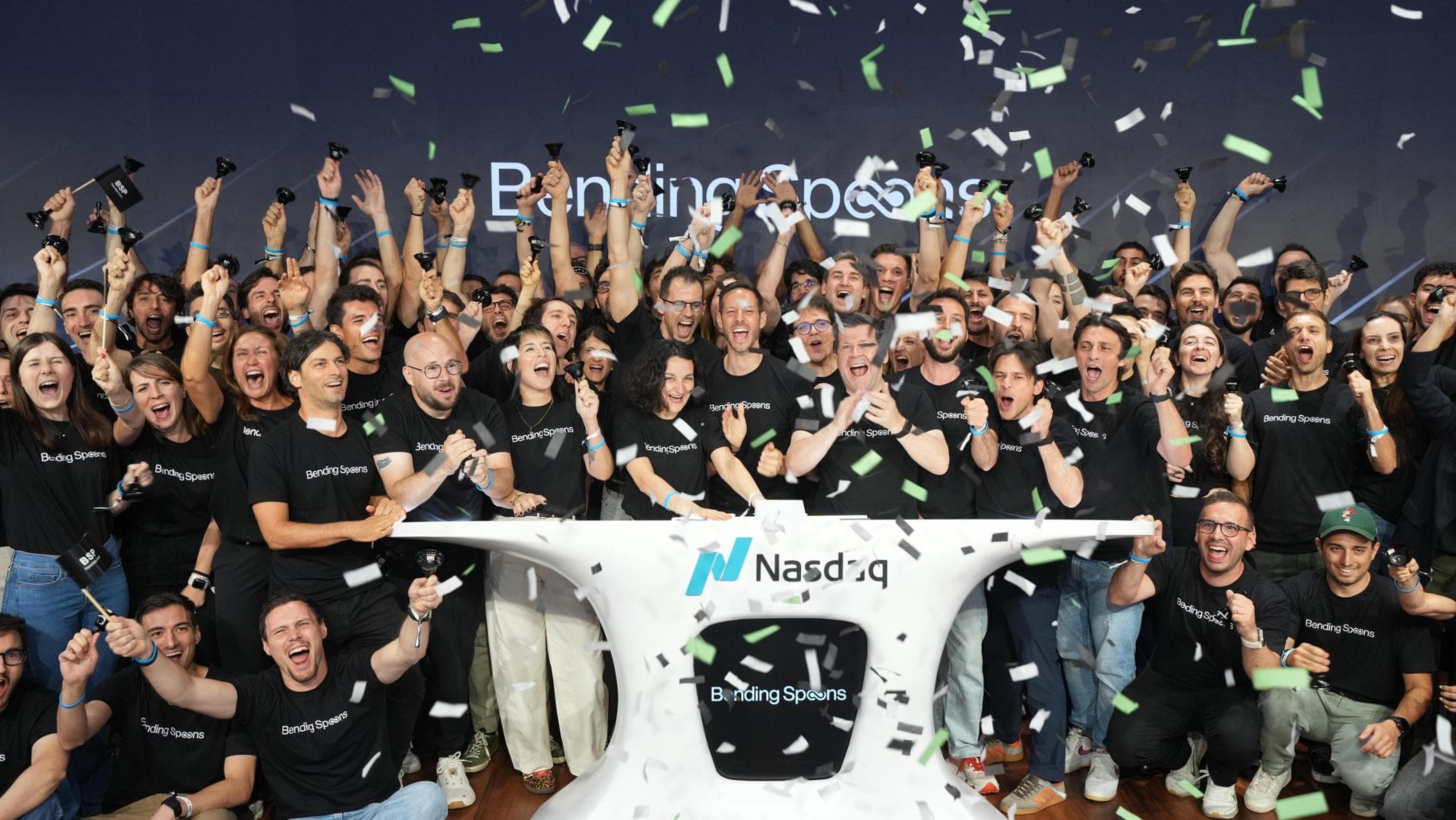
On 1 July 2026, Bending Spoons rang the opening bell at Nasdaq and began trading under the symbol BSP. The shares were priced at $29. The company sold 34.4 million new shares and collected roughly $954 million in gross proceeds, while existing shareholders sold another 23.6 million. It was a large American debut for a company that remains legally Italian, operationally Milanese and named after a scene from The Matrix. Even the corporate mythology has product-market fit.
Having studied finance and economics in Milan, and knowing several of Bending Spoons’ early investors, including unconventional names such as Fedez, I have followed the company since its venture-stage beginnings and through the turbulent chapters that preceded its success. They come from my earliest financial ecosystem.
Most people still describe Bending Spoons as an app developer. That description is not false, but it has aged badly. It is like calling Amazon a bookstore because that is where the receipts began. The company now controls a collection that includes Evernote, Meetup, StreamYard, Issuu, WeTransfer, Brightcove, komoot, Vimeo, AOL, Eventbrite and Tractive, alongside products such as Splice and Remini. These businesses do not form a tidy category. They form something more useful: a pool of recognizable digital assets that can be bought, rebuilt, repriced and made to finance the next purchase.
This is not an advertisement for Bending Spoons, nor a hymn to Italian genius wearing a black turtleneck. It is an attempt to understand the machine: who owns it, where decisions are made, how the legal structure supports the acquisitions, how the founders kept control while raising billions, and what can go wrong when a company becomes very good at buying companies.
The short version: Bending Spoons is a permanent owner with a private-equity metabolism

Bending Spoons buys established digital businesses, moves the important decisions into a centralized operating platform, changes the product and cost structure, and reinvests the cash generated by the portfolio into more acquisitions. The acquisitions are funded with a mixture of operating cash flow, equity and a considerable amount of debt. Management says it intends to hold acquired businesses indefinitely and has not sold a material company. That makes it different from a conventional private-equity fund, which normally buys with a stated exit horizon, but the family resemblance is difficult to miss.
- Acquire: target digital products with established brands, users, data, subscriptions or distribution.
- Centralize: move capital allocation, hiring, technology, analytics, marketing and strategic decisions into the Bending Spoons platform.
- Transform: redesign products, rebuild infrastructure, change pricing, reduce or reorganize teams and concentrate resources on the parts expected to produce the best return.
- Compound: use the resulting cash flow, together with new debt or equity, to acquire the next business.
The polite term is a software conglomerate. The fashionable term is a compounder. The blunt term is a roll-up with permanent capital. All three are useful, as long as we remember that a label is not an analysis.
From a failed startup to an acquisition platform

The story begins before Bending Spoons. In 2010, Francesco Patarnello, Matteo Danieli and Luca Ferrari started Evertale, a Copenhagen-based photo-sharing startup. It raised about $1 million and failed by 2013. This part is worth keeping because startup histories are usually edited backwards: the successful company appears inevitable, the abandoned products become “experiments,” and everyone was apparently learning exactly the lesson required by the next funding round.
Evertale was liquidated. Roughly $40,000 remained. The three founders joined Luca Querella and Tomasz Greber and used what was left to start Bending Spoons ApS in Denmark in 2013. The early model was not to build one sacred product and defend it forever. The company tested, acquired and operated mobile applications, allocating talent and marketing money according to performance. That habit—treating products as a portfolio and capital as something to be moved ruthlessly—became the seed of the current system.
| Year | Corporate development | Why it matters |
|---|---|---|
| 2010–2013 | Evertale is founded, funded and ultimately liquidated. | The founding team learns that affection for a product is not a business model. |
| 2013 | Bending Spoons ApS is established in Copenhagen. | The original legal home is Danish, not Italian. |
| 2015 | Bending Spoons S.r.l. is incorporated in Italy. | The center of gravity moves toward Milan. |
| 2017 | Cross-border mergers consolidate the structure in Italy; the company becomes Bending Spoons S.p.A. | The Italian parent becomes the surviving platform and gains the corporate form needed for a broader shareholder base. |
| 2018 | The group already uses product and intellectual-property subsidiaries; a partial demerger and share cancellations reshape the capital. | The legal architecture starts looking like a group, not a studio. |
| 2019 | H14, NUO Capital and StarTIP acquire an aggregate 5.7% interest. | External Italian capital enters while the founders retain the voting core. |
| 2022 | A financing package of about $340 million is announced: roughly $40 million of equity and $300 million of debt. | The acquisition engine becomes meaningfully leveraged. “Funding round” sounds friendlier, but the debt still expects to be repaid. |
| 2023–2024 | Baillie Gifford, Cox, NB Renaissance and Durable Capital join successive equity rounds. | The shareholder base becomes institutional and international. |
| 2025 | Bending Spoons raises $710 million of equity at an $11 billion pre-money valuation and arranges a $2.8 billion debt package. | The balance sheet is prepared for much larger targets. |
| 2026 | The company lists on Nasdaq as BSP. | Public equity becomes another source of acquisition currency, but founder control remains intact. |
What it bought, and what each purchase really adds
The portfolio looks eclectic only if we focus on what the products do. If we focus on their economic characteristics, the logic becomes clearer. Many have large installed user bases, familiar brands, recurring subscriptions, valuable data, or a position in a mature category where creating a new competitor from zero would be expensive. Bending Spoons is often buying distribution that already exists and then changing the economics behind it.
| Business | Acquired | Strategic asset brought into the group |
|---|---|---|
| Evernote | 2023 | A globally recognized productivity brand, a large user base and subscription revenue. |
| Meetup | 2024 | A durable community network with local groups and strong brand recognition. |
| StreamYard | 2024 | Browser-based live-video production and creator subscriptions. |
| Issuu | 2024 | Digital publishing tools, content archives and professional users. |
| WeTransfer | 2024 | Mass-market distribution, creative-professional users and one of Europe’s best-known internet brands. |
| Brightcove | 2025 | Enterprise video infrastructure, customers and recurring contracts. |
| komoot | 2025 | A European outdoor-planning community, maps, routes and subscription potential. |
| Vimeo | 2025 | Video hosting, enterprise software, creator relationships and a public-company-sized operating platform. |
| AOL | 2025 | A huge legacy audience, advertising inventory and a brand that has survived several corporate funerals. |
| Eventbrite | 2026 | A two-sided events marketplace, payments flow and global organizer distribution. |
| Tractive | 2026 | Connected-pet hardware, subscriptions and a direct consumer relationship beyond pure software. |
The table is not exhaustive. It omits several applications and operating entities, and it should not be read as a claim that every acquisition followed the same script. It shows the direction of travel: from individual mobile apps to products, then to companies, then to platforms large enough to have their own corporate weather systems.
The operating playbook: centralize judgment, then move fast
The real product of Bending Spoons may not be any app. It may be the operating system used to decide what happens to all the apps. The company describes a centralized platform of people, proprietary technology and data. Hiring standards, resource allocation, product analytics, pricing, marketing, financing and acquisition decisions sit close to the center. Acquired companies provide brands and users; Milan provides the doctrine.
This creates speed and consistency. A shared data stack can compare user behavior across products. A central engineering organization can reuse infrastructure. A single capital-allocation process can move money toward the projects with the highest expected return instead of giving every acquired chief executive a ceremonial budget and a motivational off-site. It is efficient because it refuses to treat every subsidiary as a republic.
The same centralization also explains the controversy that sometimes follows acquisitions. Deep transformations can include product redesigns, price increases, migrations, organizational restructurings and reductions in headcount. From the spreadsheet, this can be called focus. From the desk being removed, it has another name. Both descriptions may be true at the same time.
The model therefore depends on a difficult balance. Bending Spoons must extract more value from mature products without extracting the reason users cared about them. It must reduce duplication without erasing institutional memory. It must increase prices without converting loyalty into an export industry. Buying a beloved brand is easy compared with remaining worthy of it.
The corporate structure: one listed Italian parent, several operating layers
At the top is Bending Spoons S.p.A., an Italian joint-stock company and the Nasdaq-listed issuer. The prospectus describes the parent primarily as a holding company. Beneath it sit Italian holding and operating entities, followed by product companies, acquisition vehicles and regional subsidiaries. The exact legal chart is longer than the useful chart because acquisitions produce special-purpose vehicles with names that only a lawyer could love.
Bending Spoons S.p.A. — Italy, Nasdaq: BSP
│
└── Bending Spoons Holdings S.p.A.
    │
    └── Bending Spoons Operations S.p.A.
        │
        ├── Central operating platform
        │   ├── Capital allocation and M&A
        │   ├── Product, engineering and data
        │   ├── Marketing, monetization and pricing
        │   └── Hiring, finance, legal and shared infrastructure
        │
        ├── Italian product companies
        │   ├── AI Creativity S.r.l.
        │   ├── Mosaic S.r.l.
        │   └── Splice S.r.l.
        │
        ├── United States platform
        │   └── Bending Spoons US Inc.
        │       ├── AOL holding entities
        │       ├── Brightcove
        │       ├── Eventbrite
        │       └── Vimeo
        │
        └── European and other holdings
            ├── komoot
            ├── The Creative Productivity Group B.V. / WeTransfer
            ├── Bending Spoons UK
            └── Turbo AcquiCo / Tractive
This is a simplified organizational map, not a substitute for the full subsidiaries exhibit. The important point is the flow of authority. The listed company controls the holding chain; the operating platform centralizes the capabilities used across the portfolio; individual brands sit inside wholly or almost wholly owned legal entities. The brands can remain visible to customers while control, financing and resource allocation move upward.
How ownership evolved: the founders diluted economically, not politically
The ownership story is more interesting than a simple sequence of funding rounds. The founders allowed outside investors into the economics of the company while designing the voting structure so that control remained concentrated. This is common among American technology companies and usually described as preserving a long-term vision. It also preserves the people who define the vision, which is a convenient architectural feature.
2018: ordinary shares, employee shares and an early separation of money from votes
In 2018, after corporate transactions that included a partial demerger, buybacks and the cancellation of treasury shares, Bending Spoons had 4,761,227 issued shares: 4,058,108 ordinary voting shares and 703,119 Category E shares reserved for employees and directors without voting rights. The nominal share capital was €55,089.14. The distinction matters because the company was already separating economic participation from governance power before it became a global acquisition platform.
2019: the voting core was still entirely held by the five founders
| Founder | Ordinary voting shares | Share of voting ordinary capital |
|---|---|---|
| Luca Ferrari | 1,000,000 | 24.64% |
| Luca Querella | 971,554 | 23.94% |
| Matteo Danieli | 971,554 | 23.94% |
| Francesco Patarnello | 915,000 | 22.55% |
| Tomasz Greber | 200,000 | 4.93% |
| Total | 4,058,108 | 100.00% |
Later that year, H14, NUO Capital and StarTIP announced the acquisition of an aggregate 5.7% stake. The public announcement did not provide the exact allocation among the three investors or disclose how much was primary capital and how much came from existing shareholders. That is an important limitation. A press release is not a cap table, however much the communications department wishes it were.
2022: founders still held 70.28% before the large financing
| Shareholder | Approximate pre-round holding |
|---|---|
| Luca Ferrari | 18.46% |
| Luca Querella | 17.48% |
| Matteo Danieli | 17.46% |
| Francesco Patarnello | 16.88% |
| Four operating founders | 70.28% |
| NUO Capital | 3.59% |
| StarTIP | 3.59% |
| H14 / Holding Italiana Quattordicesima | 1.42% |
| Marco Pazzaglia | 1.32% |
| Nimble Ventures | 1.10% |
| Red Circle | 0.94% |
| Other shareholders, including roughly 200 small investors | Balance |
The 2022 financing was widely reported as a $340 million round, but the composition matters: about $40 million was equity and roughly $300 million was debt. The company therefore expanded its purchasing capacity without accepting the dilution that a $340 million equity issue would have created. Debt is excellent at avoiding dilution right up to the point when it begins setting the calendar.
2023–2025: institutional capital arrives
In 2023, Baillie Gifford, Cox Enterprises and NB Renaissance joined the shareholder base, with existing investors including NUO Capital and StarTIP also participating. Executed primary issuances during the year totaled approximately €66.4 million according to the prospectus. In February 2024, another $155 million of primary equity was raised at a $2.55 billion post-money valuation, with Durable Capital joining. If we divide the new money by the post-money valuation, that round represented about 6.08% of the company on a simple theoretical basis.
In October 2025, Bending Spoons raised $710 million at an $11 billion pre-money valuation. Only $270 million was new capital for the company; $440 million funded secondary sales by existing holders. The distinction is again useful. Primary capital strengthens the balance sheet. Secondary capital strengthens somebody’s bank account. Both may be legitimate, but only one buys the next company.
The same period brought a $2.8 billion debt package. By then, equity was no longer the sole engine and not even the most dramatic one. Bending Spoons had built an acquisition structure that combined founder control, institutional validation, portfolio cash flows and access to large credit facilities.
The Nasdaq IPO: public capital, private-style control

Before the IPO, the company simplified several classes of shares and completed a series of stock splits. The mechanical changes sound dramatic—a 20-for-1 split in March 2024, a 10-for-1 split in April 2026 and a 1-for-2 reverse split in May 2026—but the net effect was simply to multiply the pre-March 2024 share count by 100. Splits alter the number printed on the certificate, not the portion of the pizza. Financial markets occasionally require several documents to explain fractions.
After the base IPO offering, Bending Spoons had approximately 635.2 million shares outstanding: about 325.0 million ordinary shares carrying one vote each and 310.2 million Class A shares carrying five votes each. The Class A shares have the same economic rights as ordinary shares but superior voting power. They can convert into ordinary shares one-for-one and automatically convert in certain transfers or other specified circumstances. Ordinary shares cannot become Class A shares. Ladders, as usual, work in one direction.
| Holder after the base IPO | Economic ownership | Voting power |
|---|---|---|
| Luca Ferrari | 13.03% | 21.93% |
| Matteo Danieli | 12.20% | 20.65% |
| Luca Querella | 11.95% | 20.23% |
| Francesco Patarnello | 11.76% | 19.90% |
| Four controlling founders | 48.94% | 82.71% |
| Baillie Gifford | 5.72% | 1.94% |
| Cox | 4.25% | 1.44% |
| Galileo Quattordici | 3.55% | 1.20% |
| Durable Capital | 3.08% | 1.04% |
| StarTIP | 2.51% | 0.85% |
| HE Holdco V | 1.00% | 0.34% |
| Public, other investors and employees | 30.94% | 10.48% |
The four controlling founders did not sell Class A shares in the IPO. Their combined economic ownership fell from approximately 51.74% before the transaction to 48.94% after it, largely because the company issued new ordinary shares. Their voting power moved only from about 84.26% to 82.71%. In practical terms, public investors received exposure to the economics while the founders retained the steering wheel, the map and the right to choose the next destination.
The external-investor percentages above are recalculated against total outstanding ordinary and Class A shares. Some tables in the US filings show percentages only within the ordinary class, which produces larger-looking figures for investors who own no Class A shares. After listing, market trading can of course change individual positions, so this is a transaction-date ownership map, not a live shareholder register.
Employees own options; founders own votes
Employee participation has existed in different forms since at least the Category E shares of 2018. The later system relies heavily on options. The prospectus says that in 2025, 84% of eligible employees chose to exchange part of their cash compensation for options, with an average conversion of 28%. As of 15 June 2026, 36.3 million options were outstanding at a weighted-average exercise price of about $0.281, and the 2026 incentive plan permitted up to 51 million ordinary shares.
This can create meaningful upside for employees and align them with the equity story. It also means the simple ownership table is not fully diluted. Options exercised over time can increase the ordinary share count and reduce everyone else’s percentage. The philosophical tension is more immediate: employees are invited to convert salary into a claim on future value while the founders retain enhanced voting rights. Equity culture is beautiful, especially when rent in Milan continues to request euros.
Why the model can work
First, the supply of targets is unusually rich. The internet is full of products with strong brands, aging infrastructure, distracted corporate owners and monetization that has not kept pace with their user base. Large technology groups often lose interest in non-core products. Founders become tired. Public companies become cheap. Bending Spoons can buy a business that already solved the hardest early problem—becoming known—and apply a more disciplined operating system.
Second, centralization can produce genuine economies of scale. A portfolio company does not need to rebuild every analytical tool, payment system, growth process, legal function or recruitment machine. Better data can improve pricing and retention. Shared talent can attack the most valuable problems. The company’s unusually selective hiring also concentrates capable people inside the platform, though the same intensity may not suit every employee or every acquired culture.
Third, permanent ownership changes the optimization horizon. There is no fund clock forcing a sale after five years. If management is right about the underlying asset, it can keep compounding cash flows and avoid the transaction costs of repeated exits. This is the Berkshire Hathaway analogy that every ambitious compounder eventually meets. The analogy is flattering. The interest expense is less poetic.
Where the machine can break
1. Leverage changes the definition of patience
Debt accelerates acquisitions and protects existing shareholders from dilution, but it turns operating problems into financing problems. Interest, covenants and refinancing dates do not care about long-term vision. If cash flows underperform, or if capital markets become less accommodating, the company may have to slow acquisitions, cut more deeply or issue equity on worse terms.
2. Integration complexity does not scale linearly
An app can be migrated. A large public-company acquisition brings enterprise customers, compliance requirements, legacy contracts, multiple jurisdictions and teams with their own ways of working. The portfolio now spans consumer subscriptions, advertising, enterprise video, marketplaces, communities and connected hardware. A shared operating system is powerful only if it remains more intelligent than the variety it is trying to govern.
3. Optimization can consume the brand it monetizes
Users tolerate change when the product becomes better. They resist when price moves faster than value or when familiar features disappear. The group’s targets often carry emotional residue: people have years of notes in Evernote, creative workflows in Vimeo and WeTransfer, communities in Meetup, routes in komoot. These are not anonymous databases. Trust is an asset, although accountants have yet to find a satisfying depreciation schedule for it.
4. Founder control reduces one risk by increasing another
The dual-class structure protects management from short-term market pressure and hostile shifts in strategy. It also limits the ability of ordinary shareholders to change leadership if capital allocation deteriorates. Concentrated control is efficient when the controllers are right. It remains concentrated when they are wrong.
5. The acquisition treadmill must keep finding attractive steps
As Bending Spoons becomes larger, small deals move the needle less. Larger deals bring more competition, more leverage and more integration risk. The company may have a long runway, but the definition of a useful acquisition keeps growing with its market value. Eventually, even Silicon Valley’s attic becomes expensive.
What Bending Spoons actually is
Bending Spoons began as a second attempt by founders whose first company failed. It became a mobile-app portfolio, then an operator of digital products, then an acquisition platform, and finally a listed software conglomerate with billions in purchasing capacity. Its advantage is not that Italians suddenly discovered apps. It is that the company built a centralized system for selecting assets, allocating people and capital, and making changes that many conventional owners avoid.
The legal structure supports that system. The Italian listed parent controls holding and operating layers; the subsidiaries isolate products and acquisition vehicles; institutional capital expands the balance sheet; debt magnifies the available firepower; employee options recruit talent; and Class A shares preserve founder authority through all of it. Every component solves a different constraint. Together, they form the machine.
The bullish reading is that Bending Spoons has invented a durable European technology compounder: a permanent home for neglected digital assets, operated with unusual analytical discipline. The bearish reading is that it is building an increasingly leveraged collection of mature internet brands whose users may not enjoy being optimized. The honest reading is that both mechanisms are present, and the financial results will eventually tell us which one compounds faster.
For now, the company has done something rare. It did not move to Silicon Valley to be purchased. It stayed in Milan, built a balance sheet, and began purchasing Silicon Valley instead. The bell at Nasdaq was not the end of that story. It was the sound of the machine gaining another currency.
Sources and methodology
This analysis relies primarily on company filings, corporate-registry documents and transaction announcements. Historical percentages are snapshots at specific dates and are not directly comparable unless the share class, denominator and treatment of treasury shares are consistent.
- Bending Spoons 2026 final prospectus
- SEC subsidiaries exhibit
- Nasdaq IPO closing announcement
- 2017 Italian cross-border merger notice
- 2019 TIP investment announcement
- AIFI report on the 2022 financing and pre-round ownership
- 2023 institutional-investor announcement
- 2024 $155 million equity round
- 2025 $710 million equity financing